How the Georgia Bulldogs Have Their Place in the November Midterms in Georgia

By:Peyton Jenkins

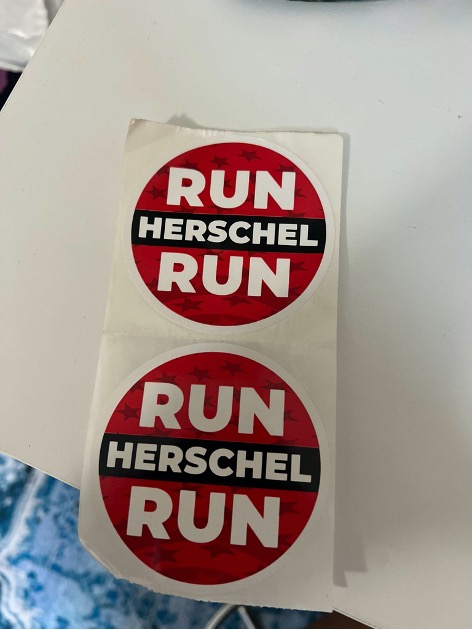
The Run Herschel Run sticker worn by students at home football games. Photo/Peyton Jenkins

Can aligning with the University of Georgia Bulldogs be enough for a candidate to get over the touchdown line? Brian Kemp, Herschel Walker and Burt Jones are just some of the candidates this election cycle that are branding their campaign with football. Whether that is being a household name and legend as a player like Walker, or hosting tailgates for every Athens gameday like Kemp. This brand is inspired by likeability and being relatable to the average voter in order to win the election, but is it enough to get over the finish line?

Why it’s Newsworthy: This story is one that can show emerging trends in politicians in Georgia and the Southeast, and a new kind of candidate we are seeing: former football players. The emerging brand that is football can have enormous benefits to candidates likeability, and could possibly be the one thing that can get a football player in the position to create laws.

Joseph Watson Jr., Carolyn Caudell Tieger Professor of Public Affairs Communications at Grady College of Journalism and Mass Communication at the University of Georgia spoke about how football is impactful for many people regionally in the Southeast but especially in Georgia. One example regionally is Coach Tommy Tuberville from Alabama being a Senator.

“The college football legacy predates the professional football legacy in places like Georgia and the Southeast,” Watson said. He went on to discuss that because of this, people have more of a loyalty to college football here, even when they did not go to school here.

Ryan Kerley, a reporter and content creator for Dawg Post and UGA student that covers Georgia football, agrees with this testament, and says that college football is more than football in Georgia; it is part of a culture in the South.

According to Watson, the effectiveness of candidates using football as part of their brand has to do with the beer test” in politics. The more likely a voter is to want to sit down and have a beer with the candidate, the more likely they will be elected to office. Watson describes using football as part of a campaign brand can make the candidate more relatable and likable to voters and push them forward to get more votes.

Walker, a conservative currently running for the United States Senate and previously a running back for UGA,  has mobilized on his already established brand of football, including adding a football to his campaign logo as well as having stickers at numerous UGA games that say, “Run Herschel Run”.

Herschel campaign image featuring the use of a football and UGA football team colors. Photo/ Courtesy Herschel Walker campaign site

Burt Jones, a previous conservative Georgia state senator who is running for Lieutenant Governor in Georgia, has also managed to include football in his brand. In one of his campaign advertisements, he speaks about how he played for the Georgia Bulldogs and even features a picture of himself in uniform on his campaign website.

Burt Jones features as a UGA football player on his campaign website. Photo /Courtesy Burt Jones campaign site.

Governor Kemp has even managed to host tailgates in Athens and allow for the public to see him as any other person, which has allowed for him to connect with voters more and allow for a real relationship with the population, rather than standing on a pedestal.

In recent years, political actors have capitalized on football for both social mobilization and political propaganda, creating a network of relationships between football, politics and society. Football may be an effective tool for campaigning but Kait Branson one of the campaign managers of War Room Strategies, a campaign PR firm, says it cannot get someone over the finish line.

“The problem is not using football as your brand but allowing football to be your only brand and I think that’s when you can get in trouble.” Branson said. She went on to say that in her work in many southern state campaigns, people in Tennessee would elect Peyton Manning as their governor in a heartbeat just because he is likable and seen as a legend.

The brand of the red and black, beer and tailgating is effective in Georgia and gives the candidate the edge, but it is not something to be relied on to be seen as an effective leader and politician. Adding more to this brand can be helpful, and come November, we can see how impactful this will be for the three candidates on the ballot.

Crawford home transported back in time

by Peyton Jenkins and Clara Kiker

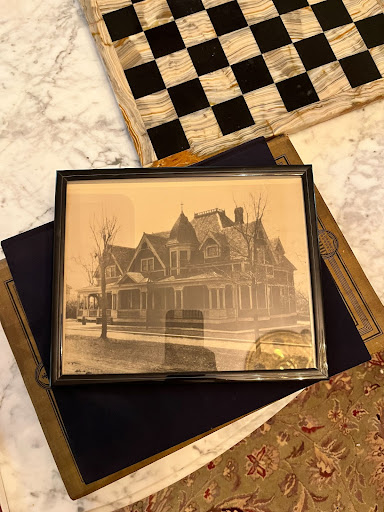
(Left)The historic home in Crawford taken in 2022. The Sheridan couple repainted the home purple because it is the wife Sandra’s favorite color . Photo/Peyton Jenkins (Right) The home in Crawford photographed in 1901. The couple had this framed image hanging in their house to show the deep history of the house. Photo/Clara Kiker

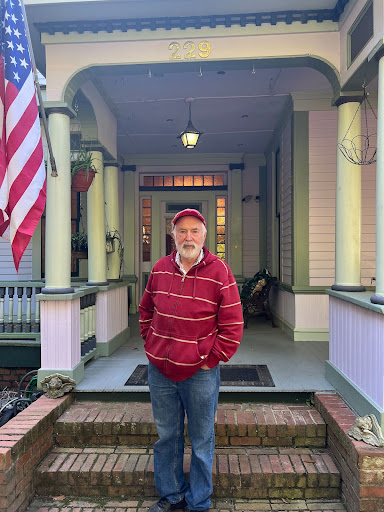
Tom Sheridan has spent 15 years uncovering the beauty of his Crawford home, which was covered three times over in white paint and now has hues of lavender and seafoam green that draw attention from the street and give the home charming curb appeal. 

Though describing himself as “a non-historian,” Sheridan, the former owner of an engineering design company, poured his time and resources into uncovering the history within the house. He educated himself about why each item in the home was chosen and what they meant at the time, from the pine walls to the pocket doors to the butler’s pantry.

“There’s a lot of craftsmanship that went into this building,” he said, adding. “To reconstruct this house right now would probably cost you $3 million. At one time there was over a million dollars worth of this pine.”

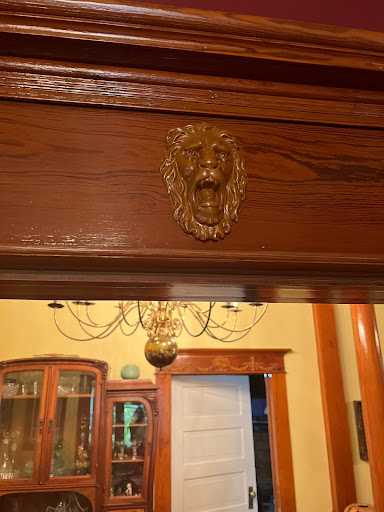
When he and his wife, Sandra, purchased the Victorian home, all of the detailed woodwork was hidden. It took them over a year and a half to strip the paint from the woodwork throughout the home, uncovering details such as a lion motif above the door in the dining room.

“It was completely painted over, there were so many coats of paint on this house you would not believe it,” he said.

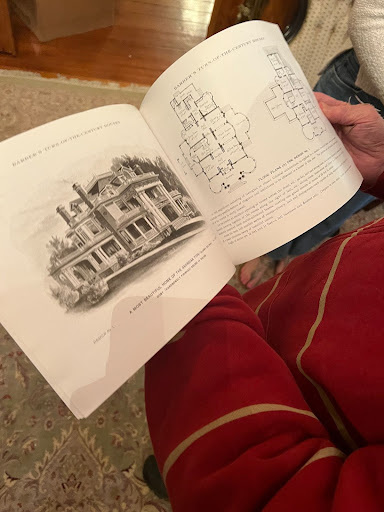
He discovered that “Barber’s Turn-of-the-Century Houses” was the catalog used for the floor plans for some homes in the county since the 1900s. Fireplaces, shutters, and paneling used for walls and ceilings were some of the home’s elements that were included in the catalog. They refinished the rare copper ceiling that now casts a shine in the dining room.

The refurbished wood-paneled rooms, such as separate men’s and women’s parlors near the entrance, and relevant time pieces, such as a portrait of King Louis XIV of France, now serve as a history lesson for guests.

“This place was a mess,” he said. “It’s all been painstakingly put back the way it should have been.

ABOUT THE HOUSE
Size: Four bedrooms, three bathrooms, 3,693 finished square feet plus another 2,000 unfinished square feet on the third floor. 

History: Jack Stokley, who was known as a “master builder,” worked with architect Frank Barber on the home, which began construction in 1900 and took around two to three years to complete the project, Sheridan said. The home has gable trim that runs along the steeple and in the floor plan and paint color enable each room to be “completely different from the other.” Sheridan said. The Sheridans purchased the home in 2005. 

Favorite design elements: Having high ceilings that were the same height throughout the home was important to the Sheridans. In other homes built during the same era, “you would have a 10-foot ceiling and a 12-foot ceiling and then in the next room your head hits the ceiling,” which was mainly due to poor construction and financial constraints, Tom said. Copper ceilings in the formal dining room are rare, he said. 

Favorite room: Sheridan said his favorite room is the men’s parlor located on the left side of the entryway. Large floor-to-ceiling pine doors would close the men’s parlor off from the rest of the house after dinner parties so that the after-dinner cigar smoke would not bother the women, he said.

Tom Sheridan poses for a photo on Oct. 10 on his front porch in his Crawford home. The porch was repainted by the Sheridan family in a mix of pinks, greens and purples because it is Sandra Sheridan’s favorite color. Photo/ Peyton Jenkins

The Crawford home is one of many in the area that used the Barber’s Turn-of-the-Century Houses” catalog to design their home and floor plan. Tom Sheridan shows one example of what can be found in the catalog, which lists descriptions and pictures for what builders at the time could purchase. Photo/Peyton Jenkins

One of the many elements uncovered by the couple was the lion that was featured above the door in the dining room. Tom Sheridan said these had even been painted over by the previous homeowners, and they had to be stripped down and replaced. Photo/ Peyton Jenkins

Designer Q&A with Jade Joyner

by Peyton Jenkins

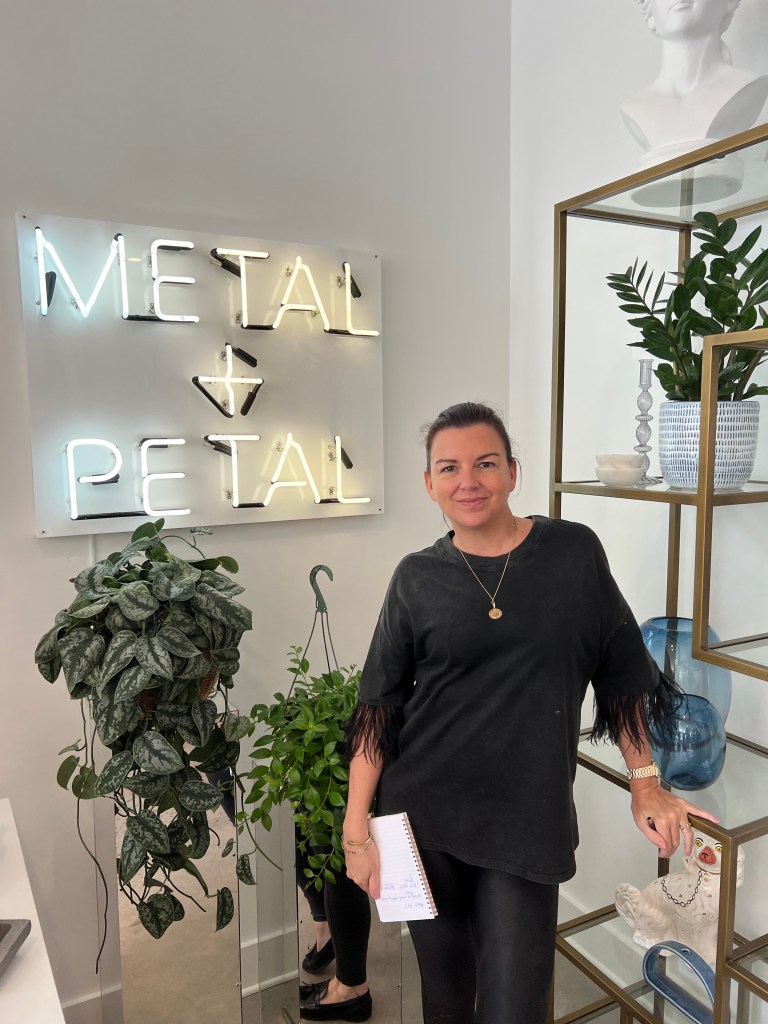
The Athens-based interior designer shows her modern traditionalist style at Metal + Petal, her store and studio on Baxter Street.

Jade Joyner poses for a photo in front of her Metal+Petal neon sign at her office in Athens on September 21. Photo/ Peyton Jenkins

Q: : I see a lot of busts and statues in your interior designs, where does it come from?

Jade Joyner (JJ): My inspiration comes from my travels to different places in Europe. I am always traveling so that I can see different cultures. 

Q: With fall season coming, what are some trends you like for the new season that you have in the store?

JJ: I look for trends outside the norm, not just the classic pumpkin spice for fall. I like dried elements for fall and layering your home by adding in more warm colors. You go for the maximalist; (in the) summer, you do the opposite and remove rugs. You do not have to transition into seasons in cliche ways.

Q: Favorite fall tip?

JJ: Go outside into your yard and get limbs and branches and put it into a vase.

Q: For the game day suite you designed in Athens, what made you step away from the bold colors of red and black and go for a more neutral and muted look?

JJ: I think expected is rather dull, we wanted to embrace the idea of football with the art frame tv and great bar, we didn’t need to give a nod to Athens. We wanted it to be inspired but not themey.

Q: What is an issue you have with clients or shoppers sometimes?

JJ: Americans are used to fast fashion and fast design, when you do something like I do it takes time. Convince them that waiting on that amazing find is worth that $14,000 that they will spend on it. Those pieces make a room.

Q What department store does your shop most relate to?

JJ: Anthropology.

Q: There are lots of plants all in your store, why is that?

JJ: Plants are super important to bring in that natural side, they bring in fresh air and texture.

Q: How important are light fixtures in a home or a room?

JJ: Light fixtures are the jewelry of your room, mix materials and do not have glass fixtures and a glass table together.

Q: How can you create a timeless look?

JJ: Anything that you see that’s trendy on TikTok or Instagram, stay away from. You want to be ahead of the trends. Anything that you can buy at HomeGoods is already over. Stone, marble, different metals, not matching finishes, bringing in color but in a subtle way, toward grays and whites and doses of color.

Comments trimmed for length and clarity.

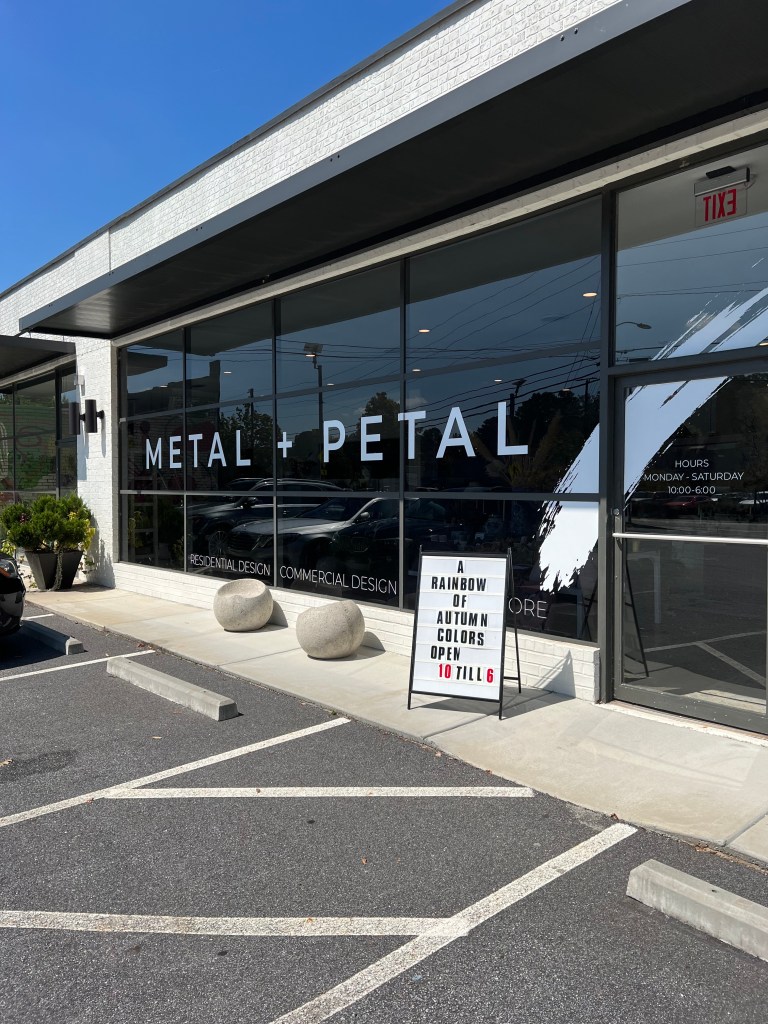
Exterior shot of Metal+Petal store located off of Baxter Street in Athens, Georgia. The name was inspired by matching a bold dark look (Metal) with lighter tones and more pastels (Petal). Photo/Peyton Jenkins

This gray toned ginger jar is part of a collection that is Joyner’s favorite piece in the store. Photo/Peyton Jenkins

Five Points Home Profile

By Peyton Jenkins

The three story wood-working facility with a built-in freight elevator located in the garage did not happen to be Dave Woodruff’s favorite room in his new home. Instead it was the guest bedroom off the foyer that featured family heirlooms such as an old mirror and sewing table, collected from his and wife Nancy’s parents’ homes.

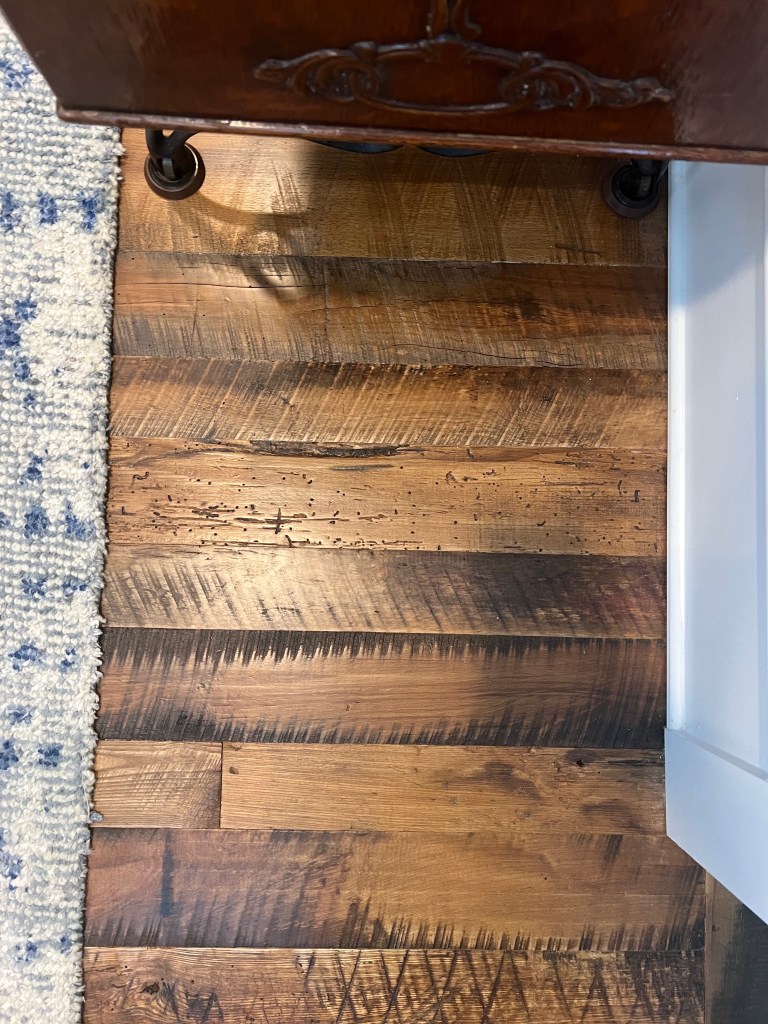
“Even though it was a brand new house, we wanted it to feel old,” he said. “Everything was intentional, and it even took us seven months to pick the right hardwood flooring.”

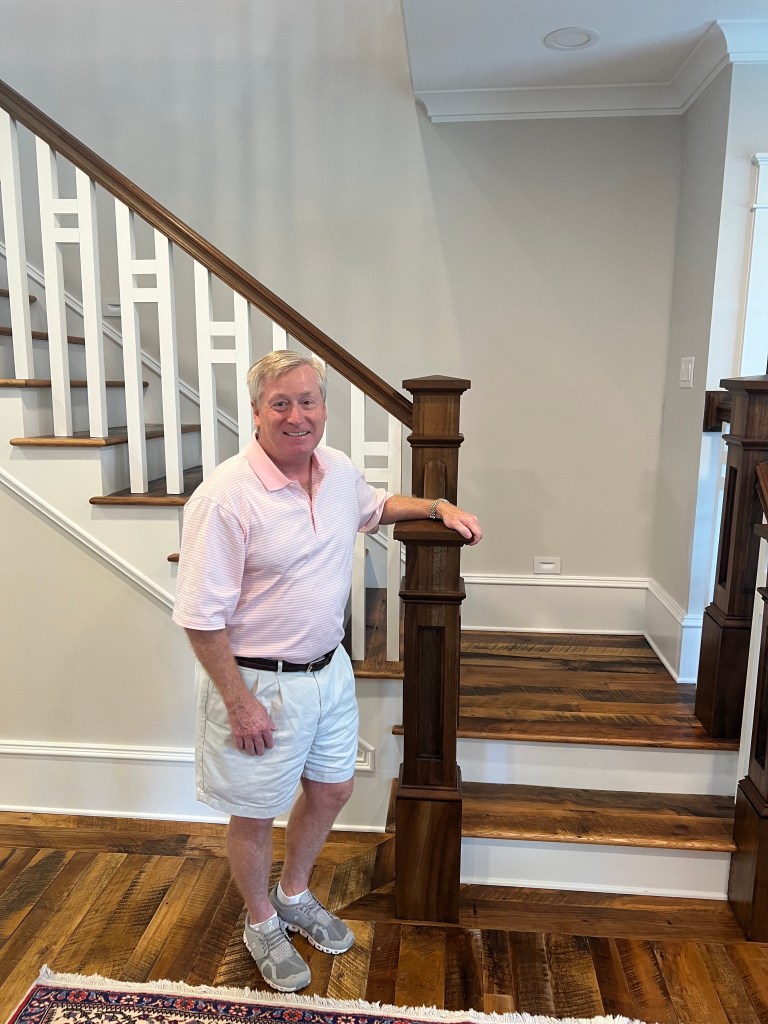
As wood is a major hobby of Daves’ Many pieces in the home were of Daves’ own creation, such as the newel posts because wood is a major hobby of his. He used African mahogany and made them in his workshop.
“When I asked the company how much they were going to cost they told me $1,700,” Dave said. “So I said ‘fine I will do it myself.’” 

SNAPSHOT

Residents: Dave and Nancy Woodruff and their 12 year old golden retriever Molly. Dave is the Senior Vice President of McGriff Insurance Services, and Nancy is a homemaker.

Location: Five Points in Athens, GA 

Size: 8,500 sq ft. 4 bedrooms/7 bath. The couple has 4 children, so they planned out one less room intentionally in hopes that the whole family would not be in the house at one time.

Year built/bought: 2020, moved the house that was previously there and started from scratch.

Design team:Tyler Davis of Athens Building Co.; architect Richard Dooley . Tyler mentioned that the hardest thing about the homebuilding was making sure the amount of impervious material was lower than 40% as with Athens ordinances. They managed to make a grassy slope in their driveway to have it reach 39.99% and there can be no more add ons or even a porch added to the home. 

Architectural style: Craftsman

Favorite architectural elements: Natural lighting and open spaces stand out to the couple. “It’s a pretty bright house, even on dark days,” Nancy said. She did not want the home to feel “sectioned off”, but instead wanted there to be a flow between rooms. They decided to make the planks on the ceiling go in the direction of the roofing to make the home feel taller and less cut off. 

Interior design style: Craftsman style with a mix of dark woods, light blues, whites and plenty of natural pieces. Nancy said she wanted nature to flood in with flowers and bird decor.

Favorite interior design elements:  They picked sheetrock gray for the interior  walls, and featured many windows to allow for it to always be bright when in the home. The mahogany doors inside  are dark brown as compared with the almost stark white walls to allow for some differentiation. 

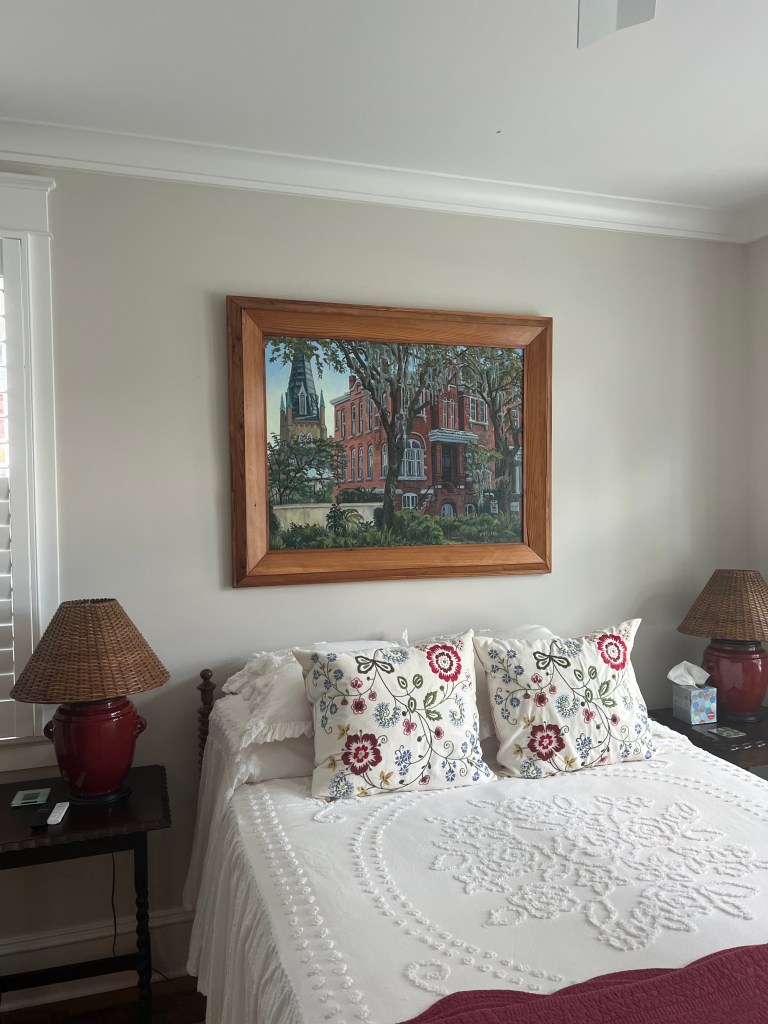
Favorite Item: Dave’s favorite item is a painting in the first guest bedroom downstairs. The painting is of Nancy’s childhood home, a brownstone located in Savannah, Georgia. The frame is made of repurposed wood from the roof of the brownstone.

Resources: Some dressers, chests, doors and newel posts are partly made from Dave’s woodworking shop with equipment byFelder Group in Austria. Many items are sourced from antique shops, and others are passed down from family. 

Decor tip: Take the time to think about the colors and furniture, Nancy said. “Grab a swab from Home Depot and throw it on the wall and see if it works,” Nancy said. 

Special features: One special feature of the home is the three story wood-working facility. When asking the builder Tyler the most difficult thing about that project was he mentioned the water runoff that came from University Drive under the home. “We had to bury that [water runoff] and run it around the woodshop since the woodshop goes 10 feet underground,” he said. “It took us a total of 60 days before we put the foundation in.” The stained glass on sliding doors of the pantry has  been passed down through Dave’s family, and he designed the doors to allow for the glass to be represented.

Dave Woodruff poses for a photo on August 31 in front of his hand made newel posts in his Athens home. He made eight in total from african mahogany. He made several adjustments to each one to ensure perfection in size with the banister, all done in his own wood-working shop in the home. Photo/Peyton Jenkins

The homeowners wanted to reuse as many materials as they could in their new home to make it feel lived in and settled. The guest bedroom on the main floor, and it features a painting of the wife’s parents’ brownstone with the frame made of the wood that was on the roof of the parents’ home. The bed was also constructed of wood used from an old bed of one of their late grandparents. Photo/Peyton Jenkins

When picking the hardwood flooring, the Athens homeowners opted for one made of many old wooden panels. They liked the scratches in the wood because it reminded them of their old house where the four dogs they used to have would constantly be scratching on the ground. The wood was reused from old barn houses, keeping in tune with the theme of feeling old yet new. Photo/Peyton Jenkins

Social Media:

Q&A with Gena Knox

By Peyton Jenkins

Real estate agent Gena Knox of Ansley Real Estate describes the market trends in Athens, and the microculture found here that has inspired the flight of many Atlanta families east to Athens.

Gena Knox poses in her office in Five Points in Athens on November 29. She started her own business Ansley Real Estate in February 2022. (Photo/Peyton Jenkins)

Q: How long have you been practicing real estate in Athens?

Gena Knox: So we actually just opened the Athens branch of Ansley in February, but I’ve had my license for four years, I’ve just kind of got in at a good time. I’ve lived in Athens for almost 20 years. So I know a lot of people just from living here. I was immediately successful in the job because I know people who have lived here for so long that it was easy for me to find buyers and sellers.

Q: What are some trends you have seen sparking up in Athens?

GK: The younger couples, or the millennials that are buying their first home, I think nice lines like clean lawns are really trending, and you can see a lot of that in new construction. They like very simple kitchens and baths, you know, white marble, dark fixtures, the clean lines, and then a lot of scrollwork pattern in detail, and that shows really well.

Q: What age groups are moving to Athens?

GK: Millennials are moving here. They’re choosing Athens over Atlanta, because it has a lot of appeal as a slower paced lifestyle, but we still offer great restaurants and things like that. But we also see a lot of empty nesters retiring here. Those two different demographic picks are very popular.

Q: What is the average price point for homes in Athens?

GK: $370k is the average home sale for Clarke County. We definitely have seen our highest sales since COVID with many located on Milledge Circle. One home was listed for $3.2 million, and we sold it for $3.8.

Q:Has there been an influx of people moving to Athens in recent years?

GK: We have seen a flight of people from Atlanta, but also New York, Texas, and Colorado. I think people just wanted a slower pace. We’ve had people come from California, and just buy a house sight unseen here and never been to Athens just heard it was a cool thing. You can get so much more bang for your buck here. So it has been fun to see Athens grow, and I don’t really see it changing anytime soon, especially with our football team doing so well. 

Q: How has the recession changed the way people have purchased real estate in Athens?

GK: I’m crazy busy with buyers, which is great. I feel like Athens is a little bit protected because we’re so close to the university, and the university provides so many jobs and opportunities for people. It’s not going anywhere. We’re kind of in a little bubble, where we’re not as affected as the rest of the country about the recession. I think there’s just microclimates like that all over the country anyway, but we’re unique in that respect.

Comments trimmed for length and clarity.

Social Media

The male dropout rate is a crisis going unnoticed.

by Peyton Jenkins

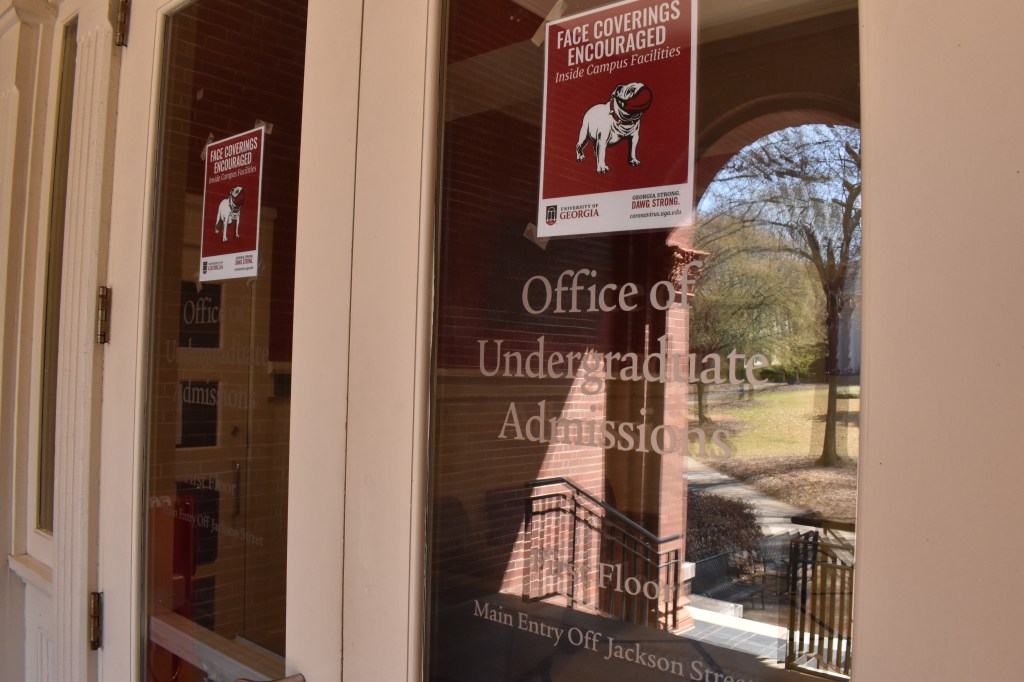
Office of Undergraduate Admission UGA captured by Peyton Jenkins

When Title IX was passed in 1972 in an effort to eliminate sex-based discrimination and ensure all students were allowed equal access to quality education, there was a 12% gap between male and females bachelor’s degree completion rates. Forty-seven years later, this gender gap has widened by 14% in the other direction. This gap for men extends beyond just college completion; male enrollment rates have dropped as well.

According to Hanna Rosin, the author of The End of Men, this gap is “the strangest and most profound change of the century, even more so because it is unfolding in a similar way pretty much all over the world.”

COLLEGE ENROLLMENT IS FALLING, MOSTLY WITH MEN

Enrollment in colleges across the country are declining, and this decline has been almost entirely driven by male dropout rates. The gap has widened significantly up to 2020, with women being more likely to enroll in college than men. According to the National Student Clearinghouse Research Center on term enrollment estimates, total first-time student enrollment was 13% lower in fall 2020 than in fall 2019. This decline has been seen largely due to the drop in total male enrollment which was over seven times larger than the drop in female enrollment. In the United States, right now, male students hold only 41% of the students enrolled in a secondary education.

Margaret Ann Amstutz, Interim Associate Provost and Dean of the University of Georgia Honors College says this is not a new issue.

“The issue of the declining number of young men on college campuses may be getting a lot of coverage now, but it is not a new issue,” Amstutz said over email. “In 2000, former UGA President Michael Adams gave a lecture at Athens Academy entitled “Educating Young Men” in which he addressed this very subject.”

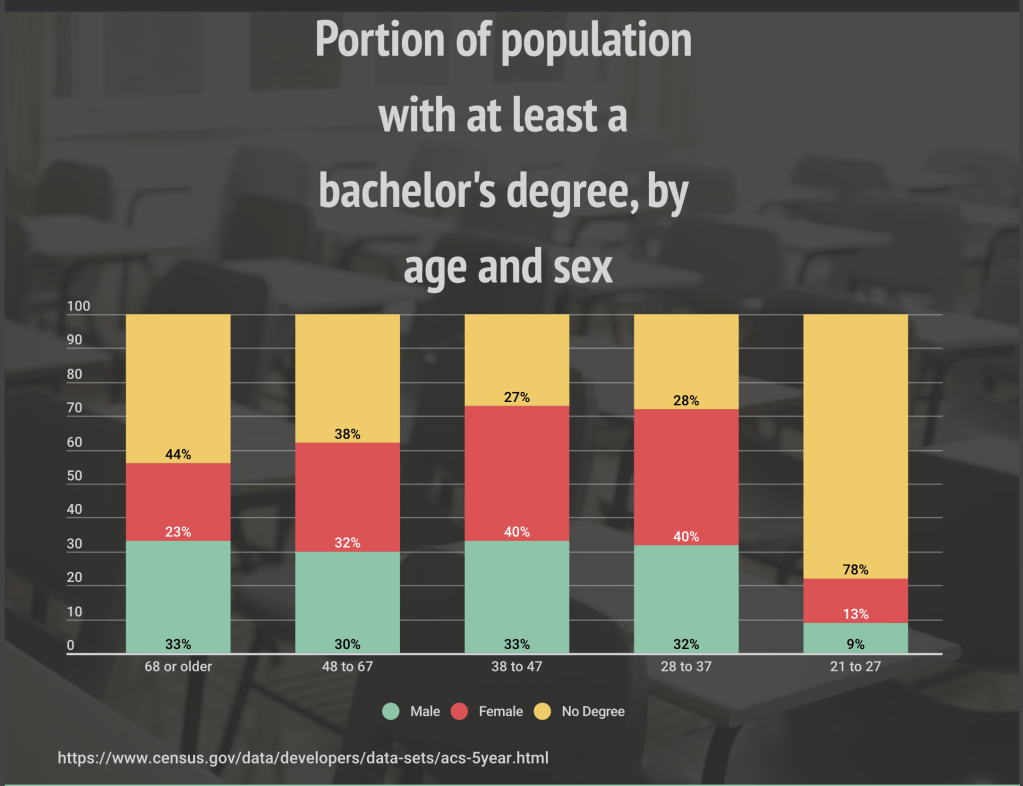
Compared to women, there is a gender gap in the completion of a bachelor’s degree for men as well. According to the U.S. Department of Education, over 1.1 million women received a BA in the 2018-19 year compared to 860,000 men. That is 74 men for every 100 women. 

As seen in the graphic below, this gap was not always so large, but the traditional gender gap is reversing when looking at ages of men and women with degrees.

According to a USA Today article, nearly 60% of students are women while only about 40% are men, an education gap that has been widening for decades.

DIFFERENCES IN RACE AND CLASS

White and Asian students are 5% more likely to enroll in college after high school than Hispanic and African-American students. Boys who underperform in middle school and high school classrooms are less likely to have upward mobility because of their failings as a child. 

Jessica Hunt, the assistant dean and director of scholarships for the University of Georgia’s Honors College and lifelong English teacher, told me in an interview that she has seen teachers treat boys differently in the classroom because of their immaturity level compared to women, and this could possibly be the cause of less males applying and finishing college. 

“I’ve seen that school tends to reward female students a little bit more than it does male students,” Hunt said in an interview. “Sometimes it’s easier to reward a female student that stays in their seat than the more interactive male student.”

WHAT IS CAUSING THIS

Richard Reeves, a Brookings Institution senior fellow, said in an interview with The Atlantic, “I’m struck by the fact that nobody seems to understand why this is happening.”

So, what exactly is causing this? Administrators, parents and researchers hypothesize on why this is a problem and how it might start in grade-school.

There have always been jokes about how girls mature faster than boys and how they are less likely to misbehave and get better grades because they can stay in their seats, but is it this difference in elementary school immaturity that is affecting men graduating with degrees? Reeves, Hunt and other researchers believe it is.

“There is a linear educational trajectory for girls and women. Boys and men tend to zigzag their way through adolescence,” said Reeves.

Another reason this is happening is because there are less male role models with men being more likely to be incarcerated leading to 80% of single parent households being led by mothers, and 75% of public school teachers being female.

Psychologist Angela Duckworth, author of the Grit, says in an Atlantic interview, “Men’s higher likelihood to drop out of college for perceived short-term gains in the labor force might tell us men are more likely to do risky things.”

Colin Smith dropped out of college his sophomore year, and now runs his own company called All Dry Services and he said you could not pay him to go back to the University of North Georgia.

“I genuinely was not good at school and could never focus,” Smith said in an interview. “I saved and worked hard for two years and now have fully started a company that is my own that is making me more money.”

I took to Instagram to ask over 2,000 people if they could see the difference in male and female students on campus, and if they knew anyone who had dropped out. The polls speak for themselves.  

The reasoning for this seems to stem from a blend of economic, cultural and biological factors that has created a scenario in which girls and women are more attached to the education pipeline.

THE IMPLICATIONS OF THE NEW GENDER GAP

Education experts and historians are not surprised, there has been a trend of women in the United States earning more bachelor’s degrees than men every year since the mid-1980s. This gender gap has not come out of nowhere, but it reveals a shift in how men participate in the economy, society and education.

Sociologist Katheryn Edin says men without college degrees are likely living a “haphazard” life detached from family, faith and work.

Gender inequality in education creates problems, no matter what direction it is in. Men are more likely to go to college than they were 10 years ago, but something seems to be constraining their growth. 

HOW CAN WE FIX THIS

At the end of the day, every person is not meant to go to college and if males want to succeed through a vocation job they are welcome to do so. But closing the gap on completion of a college degree for men is what is at stake here. It is important to focus on this aspect at a young age and assume that boys and girls should be treated the same by teachers or professors at all ages, even if the maturity is not all the way there. This issue has been ignored for too long, and it should be a priority for equality that schools and universities strive for. “Men don’t need to pull themselves up by their bootstraps,” said Kerry Frazee, director of prevention services at the University of Oregon. “No one can do it all by themselves.”

There’s a New Sheriff in Town; William’s Plan for Collaboration

Peyton Jenkins

Why it’s newsworthy: Sheriff Williams is the new sheriff after 20 years of leadership under Edwards. He has been involved in the Athens community for more than two decades and has new plans and policies he hopes will change the way the office is being run.

John Q. Williams’ aspiration as a child was to play a sheriff on a detective show like “A Man Called Hawk” rather than actually being elected as one. 

“I wanted to be a star,” Williams said.

Instead of seeking stardom in the eyes of Hollywood, Williams chose to be a star in his community. He always desired hometown glory and recognition just like an actor from his hometown; Avery Brooks. Williams found his passion for his community and realized his place as a sheriff gave him a new version of stardom.

Having never run for any political position in his life, Williams won in November and was acting sheriff on January 1. He won by 51% of the 19,000 votes cast in the Democratic primary against the former sheriff according to the election summary report.

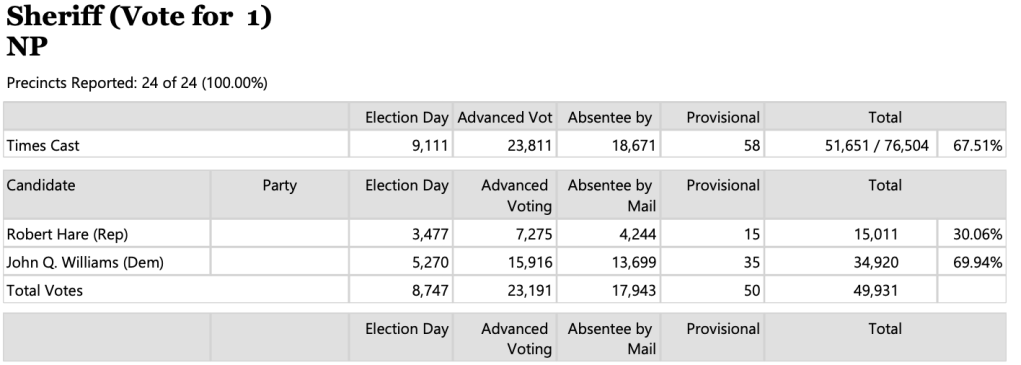
He went on to win the election with 34,920 votes. Though recalled as an upset against the previous Sheriff, Ira Edwards, Williams was confident he would win and that he had the support of his community behind him. He said there was no accountability under the former sheriff, and there was a culture of fear.

The election summary report published by Athens-Clarke County on November 6th election day. This depicts the general election on November 3rd with Williams winning the vote. (Data/ACC Gov)

Dantrel Robinson, William’s childhood friend who now resides in Alabama, said via email that he was not surprised in the slightest at the results. 

“I wasn’t shocked,” Robinson said. “He ran a consistent, clean campaign that focused on the people rather than the incumbent.”

Williams won because he has been a prominent member of Clarke County for over 20 years. A pillar of the community is how Williams is described, and it starts with the kids. This past Easter, he visited a local Target and community centers donning a bunny costume to bring smiles to children’s faces. 

“Williams understands the challenges and strengths of the community he serves, and it starts with the children,” Robinson said.

One of his most important roles was as supervisor and instructor for the ACCPD Career Development and Training Unit. 

One of his slogans for his training is, “you can’t just arrest your way out of problems.” Williams has made it his mission as sheriff and trainer to teach police officers to try to find a better way to handle things other than just straight by the book.

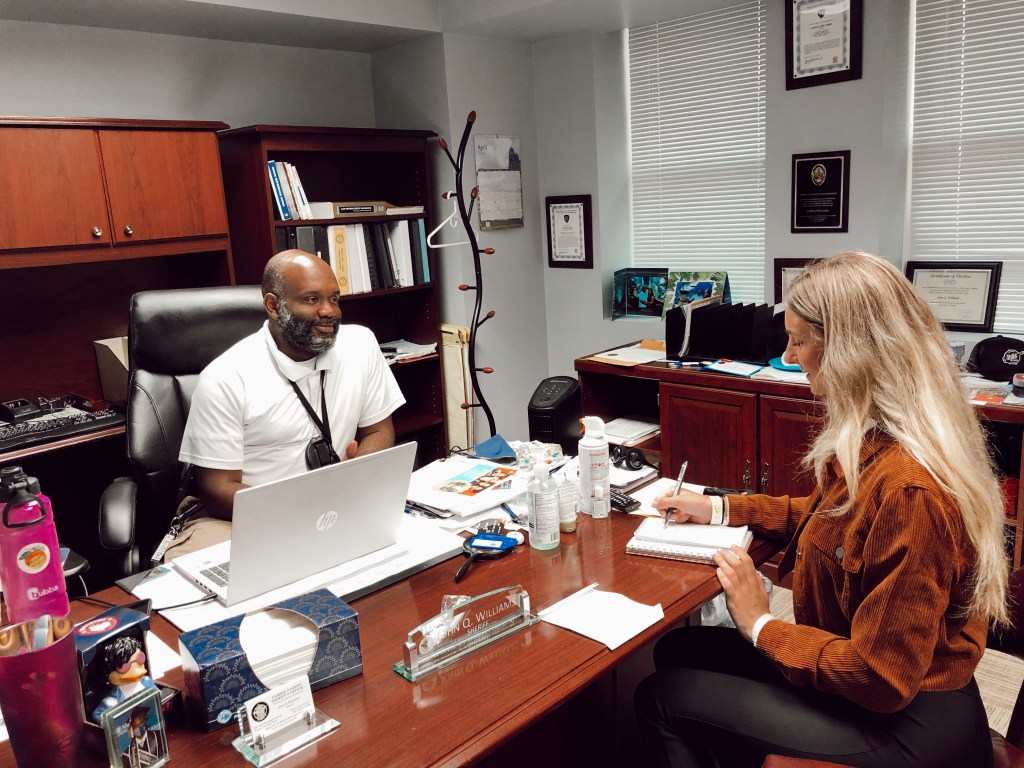
Sheriff John Q. Williams discusses policy and collaboration in his office at the courthouse on Tuesday, April 13. Newly elected as sheriff of Clarke County, he makes his views and plans known for the future of the office. (Photo/Peyton Jenkins)

One of the most important plans Williams has is getting the inmates vaccinated. The sheriff’s office worked out a partnership to help give inmates who want a COVID-19 vaccine the single-shot Johnson & Johnson dose. He said ⅓ of the inmates surveyed said they want it and it is to begin this week. 

Growing up in Gary, Indiana, Williams did not have a good relationship with authority. As a Black youth during the late 60s and early 70s, he felt prejudice against him from police to community members. 

Robinson said how the two were treated even when attending a school competition for speeches.

“Northwest Indiana was known for being one of the most racially divided areas in our country,” Robinson said. “It lurked under a veneer of passive aggressive and blatant prejudice.” 

Robinson said Williams always kept his cool and encouraged the other kids to represent their city and school and not “fight fire with fire.”  

Williams has taken what he experienced in his youth and used it for good. He said that he does not want anyone to receive the treatment he was given. Being a police officer you do have to make tough decisions and you have to hurt people, but it should not be on the basis of race or prejudice.

The training begins with emotional intelligence. Williams says that all people are reactive in situations and he tries to teach officers to take a moment and think about what they are doing.

“Ultimately, the decision that you make should be steeped in how you want to be remembered,” Williams said. “Sometimes when you take a moment, and you brief, you can overcome.”

Williams has tried to form relationships between different departments and work together; something he and other officers did not see under the former sheriff of 20 years.

“There’s a lot of interactions between the sheriff’s office and the police department and the UGA police,” Williams said. “I’ve just seen over the years that the relationship that should be there is not there.”

He has focused on bridging these relationships and has an open door policy for both the community and all of the agencies to speak out and communicate to work together.

How I wrote this story: I reached out to the new sheriff to learn about his new policy plans and ended up speaking with him for over an hour. I wrote the profile on him and incorporated many elements of his personality as well as his policies in while keeping the story interesting. I gained valuable skills in my profile writing and my ability to find a message among an hour and a half of recorded conversation.

Deborah Scott Encourages Women to be Active in Their Community

Why it’s newsworthy: Deborah Scott strives for women to support women through being one bird of a flock, and continues to mobilize women to show up in their community and have a place at the table.

Deborah Scott, the executive director of Georgia Stand-Up, says that all women have a responsibility to each other to influence change and to train the next generation of activists.

“Birds of a feather must flock together,” Scott said Tuesday night at the Women’s History Month Keynote Speech.

Scott discusses the empowerment of women and the strive for justice and equity in her Keynote Address to faculty, students and campus leaders. She was invited via Zoom for the UGA Institute for Women’s Studies.

Scott, a social rights leader and executive director of STAND-UP, gave a keynote speech at the event organized by the UGA Institute for Women’s Studies. She attempted to mobilize and inspire women — and “a few good men” — to join together and lead the charge against voter suppression in Georgia.

With around 70 participants on the Zoom call, Scott told about 70 participants on the Zoom call how the female leaders on the front lines such as Stacey Abrams, Helen Butler and LaTosha Brown are backed by more women.

“We wanna be the one in the back and pushing them and saying you can fly,” she said. 

During her talk, titled “Behind Every Great Woman are Great Women,” she gave a running theme of birds coming together and staying in a “squad.” She says that every woman has a responsibility to one another, and everyone plays a role. 

Scott and her group — STAND-UP — participated in a die-in at the World of Coca-Cola in Atlanta on Monday. She said this sent a message to large companies like The Coca-Cola Co. that voters are unhappy with what policies their campaign donations are going to. 

If women want to be in the conversation, they have to show up, which is possible through voter mobilization, she said. She said women have to show up, and this can be made possible through voter mobilization.

Scott criticized Georgia’s latest policies at the capitol, which she believes is voter suppression. Through STAND-UP, Scott  organized “Souls to the Polls” and “Party at the Polls.” She would bring black voters from church to vote, and provide food and water to voters in long lines to encourage them to stay. She said these efforts would be illegal if they were passed at the state capital. 

Scott uses this phrase to encompass her speech and use an interactive format to show videos and images of women “putting in the work.” This was one of many slides she presented at the Keynote Address.

Scott used PowerPoints and videos to keep the talk personable and interactive rather than formal. 

“I thought she did a really good job at just keeping like everyone engaged,” said Mehak Sampat, a second-year biology and psychology major at UGA. “It just felt like very like female empowerment.”

Scott wanted to get women excited, and motivated to be active in their community. She says she is getting women ready for the fight that is right now.

“You have to light your own fire, there is no baton to pass,” Scott said.

Analysis of Protests at the State Capitol

Voting rights advocates plan economic boycott to pressure Georgia firms

I believe this story uses two of the five interesting elements including impact and conflict. This article describes the protests at the Georgia State Capitol from the new voting right bill and shows how these groups are planning to boycott corporations that are not speaking up for them such as Coca Cola. This shows strong beat reporting because Greg Bluestein was there in person to witness the protests and covered the event via Twitter, which he linked in the article. He also knows information about the bill, its components and is able to keep up with embedding changes. He describes that this story matters by saying the amount of people rallying with this protest and a new law to be passed affecting all Georgians as well as affected the corps being protested against.

Quoted: Bishop Reginald Jackson (direct), Marla Cuerton (direct), Coca-Cola (indirect)

Overlooked: Representatives who are pushing the billa and their reasoning for pushing this bill to pass and a statement from the corporation about the protests.

I do not think this story passed the Topeka Test because Bluestein did not explain the bill enough and who is in support of it. He probably realized most people reading the article would already know the components and supporters.

He does not show inherent bias, but he overlooked the key players for the bill, such as the elected officials actually passing it.

Bluestein used a summary lede and layed out the information in a straightforward way starting with the subject, verb and action. The nut graf serves its purpose by giving background on what the bill is and what kind of protests and boycotts are occurring. The best quote would be “We will speak with our wallets” because it shows the protesters are taking other measures to show their disapprovement of the bill.