by Peyton Jenkins

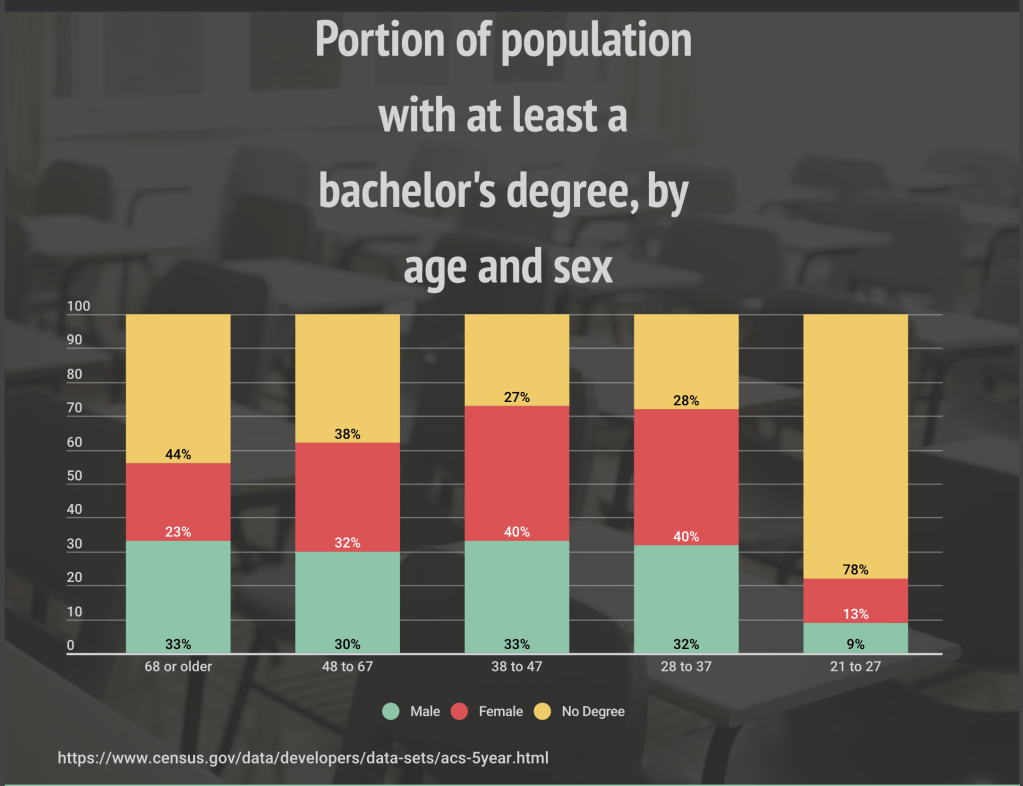
When Title IX was passed in 1972 in an effort to eliminate sex-based discrimination and ensure all students were allowed equal access to quality education, there was a 12% gap between male and females bachelor’s degree completion rates. Forty-seven years later, this gender gap has widened by 14% in the other direction. This gap for men extends beyond just college completion; male enrollment rates have dropped as well.
According to Hanna Rosin, the author of The End of Men, this gap is “the strangest and most profound change of the century, even more so because it is unfolding in a similar way pretty much all over the world.”
COLLEGE ENROLLMENT IS FALLING, MOSTLY WITH MEN
Enrollment in colleges across the country are declining, and this decline has been almost entirely driven by male dropout rates. The gap has widened significantly up to 2020, with women being more likely to enroll in college than men. According to the National Student Clearinghouse Research Center on term enrollment estimates, total first-time student enrollment was 13% lower in fall 2020 than in fall 2019. This decline has been seen largely due to the drop in total male enrollment which was over seven times larger than the drop in female enrollment. In the United States, right now, male students hold only 41% of the students enrolled in a secondary education.
Margaret Ann Amstutz, Interim Associate Provost and Dean of the University of Georgia Honors College says this is not a new issue.
“The issue of the declining number of young men on college campuses may be getting a lot of coverage now, but it is not a new issue,” Amstutz said over email. “In 2000, former UGA President Michael Adams gave a lecture at Athens Academy entitled “Educating Young Men” in which he addressed this very subject.”
Compared to women, there is a gender gap in the completion of a bachelor’s degree for men as well. According to the U.S. Department of Education, over 1.1 million women received a BA in the 2018-19 year compared to 860,000 men. That is 74 men for every 100 women.
As seen in the graphic below, this gap was not always so large, but the traditional gender gap is reversing when looking at ages of men and women with degrees.
DIFFERENCES IN RACE AND CLASS
White and Asian students are 5% more likely to enroll in college after high school than Hispanic and African-American students. Boys who underperform in middle school and high school classrooms are less likely to have upward mobility because of their failings as a child.
Jessica Hunt, the assistant dean and director of scholarships for the University of Georgia’s Honors College and lifelong English teacher, told me in an interview that she has seen teachers treat boys differently in the classroom because of their immaturity level compared to women, and this could possibly be the cause of less males applying and finishing college.
“I’ve seen that school tends to reward female students a little bit more than it does male students,” Hunt said in an interview. “Sometimes it’s easier to reward a female student that stays in their seat than the more interactive male student.”
WHAT IS CAUSING THIS
Richard Reeves, a Brookings Institution senior fellow, said in an interview with The Atlantic, “I’m struck by the fact that nobody seems to understand why this is happening.”
So, what exactly is causing this? Administrators, parents and researchers hypothesize on why this is a problem and how it might start in grade-school.
There have always been jokes about how girls mature faster than boys and how they are less likely to misbehave and get better grades because they can stay in their seats, but is it this difference in elementary school immaturity that is affecting men graduating with degrees? Reeves, Hunt and other researchers believe it is.
“There is a linear educational trajectory for girls and women. Boys and men tend to zigzag their way through adolescence,” said Reeves.
Another reason this is happening is because there are less male role models with men being more likely to be incarcerated leading to 80% of single parent households being led by mothers, and 75% of public school teachers being female.
Psychologist Angela Duckworth, author of the Grit, says in an Atlantic interview, “Men’s higher likelihood to drop out of college for perceived short-term gains in the labor force might tell us men are more likely to do risky things.”
Colin Smith dropped out of college his sophomore year, and now runs his own company called All Dry Services and he said you could not pay him to go back to the University of North Georgia.
“I genuinely was not good at school and could never focus,” Smith said in an interview. “I saved and worked hard for two years and now have fully started a company that is my own that is making me more money.”
I took to Instagram to ask over 2,000 people if they could see the difference in male and female students on campus, and if they knew anyone who had dropped out. The polls speak for themselves.

The reasoning for this seems to stem from a blend of economic, cultural and biological factors that has created a scenario in which girls and women are more attached to the education pipeline.
THE IMPLICATIONS OF THE NEW GENDER GAP
Education experts and historians are not surprised, there has been a trend of women in the United States earning more bachelor’s degrees than men every year since the mid-1980s. This gender gap has not come out of nowhere, but it reveals a shift in how men participate in the economy, society and education.
Sociologist Katheryn Edin says men without college degrees are likely living a “haphazard” life detached from family, faith and work.
Gender inequality in education creates problems, no matter what direction it is in. Men are more likely to go to college than they were 10 years ago, but something seems to be constraining their growth.
HOW CAN WE FIX THIS
At the end of the day, every person is not meant to go to college and if males want to succeed through a vocation job they are welcome to do so. But closing the gap on completion of a college degree for men is what is at stake here. It is important to focus on this aspect at a young age and assume that boys and girls should be treated the same by teachers or professors at all ages, even if the maturity is not all the way there. This issue has been ignored for too long, and it should be a priority for equality that schools and universities strive for. “Men don’t need to pull themselves up by their bootstraps,” said Kerry Frazee, director of prevention services at the University of Oregon. “No one can do it all by themselves.”
 Peyton Jenkins